

Open your last 90 days of content. Now—which 5 pieces changed a buyer’s decision?… Still thinking? Exactly! Most teams can’t. What they can show is a beautiful calendar: boxes filled, Tuesdays spoken for, heavy decks, colour-coding that would make a project manager weep with joy. It looks like control. It feels like productivity. And then finance asks a rude little question: “Show me where any of this influenced last quarter’s pipeline.”
Silence. Death stare.
Maybe a dashboard of views appears as an alibi. Maybe someone mentions ‘brand’. But if you or your CFO cannot trace its impact without a guided tour… you just have output, not outcome.
Know this first: Calendars manage time. Architectures manage traction. But most enterprise teams run on content calendars, not content architecture. And most don’t even realise this.
This is the quiet failure mode of enterprise content. High motion, low momentum. The team ships on schedule, the assets look expensive—but nothing compounds. You’re not building a case, you’re simply decorating a feed.
The symptom: Where enterprise content fails…
There’s a pattern to the chaos. And it starts with smart people doing sensible things—in the wrong order.
Silos first. Campaigns get scoped by channel or quarter, not by argument. Social wants something ‘snackable’. Events want ‘leave-behind’. Web wants a blog every Tuesday because… Tuesday. None of it adds up to a thesis. It simply adds up (the bill).
Format before idea. Someone says, “Let’s do a white paper,” as if the container is the strategy. Months later, you’ve got a handsome PDF that answers a question no buyer was asking, at the moment they needed an answer.
Repurposing by hope. The blog becomes a Pulse becomes a carousel becomes a sales one-pager—each with the same headline, now wearing a new font. That’s not remixing. That’s recycling failure. It only works when the argument is strong and the distribution is intentional.
Vanity metrics as verdicts. ‘Views’ stand in for ‘value’ because they’re the only numbers that will load quickly in a meeting. Know what? We’ve never seen a calendar screenshot in a board deck. We’ve, however, seen the absence of content architecture sink expensive budgets.
The cultural side-effects are predictable, though. Busyness becomes virtue. Teams optimise for publishing something, instead of proving something. Executives can’t map content to revenue or positioning, so ‘content’ returns to its old job title: cost centre. But worst of all:
Sales stop asking for content, not because they don’t believe in it, but because they’ve learned it won’t help them win this week.
Some of this is neglect. Most of it is random. And random acts of content don’t scale. They just scatter. And scatters are messy. If content is everywhere, impact is nowhere. And when no one can see what a piece moved, no one funds the next one.

| If any of this feels familiar, you’re not alone: |
|---|
| 🤔 7 blogs in a month → zero cited by Sales in any pipeline note 🤫 4 ‘hero’ videos → none reused after launch 😶 1 expensive white paper → no completions tied to pipeline ☹️ “Engagement rate: strong.” → Pipeline impact: non-existent 😣 Quarterly newsletter → zero forwards inside key accounts |
| That’s content architecture missing from the equation. |
The price: What it costs when content can’t be seen
Invisible content isn’t neutral, it’s expensive. Not just “we could have done better” expensive—line-item expensive.
We once audited a team with 43 live assets for a single product. Only 2 were linked somewhere near a live opportunity. 1 was genuinely helpful. The infamous $100k whitepaper no one read… that was badged as thought leadership. It was regret in PDF form.
Every hour spent on an asset that doesn’t move a decision is a hidden tax on the business. And you pay this tax three times:
Once in production. Duplicate effort, rewrites, meetings about meetings. The calendar demands its sacrifice, the outcome does not.
Once in opportunity cost. While the team is polishing a format no buyer asked for, the actual argument that would have changed a deal goes unwritten.
Once in trust. When leaders can’t trace content to revenue or to a strategic position, they don’t cut budgets out of spite, they cut them out of logic. Eventually, it’s cheaper to stop guessing.
| Here’s the simple maths your CFO understands without translation: |
|---|
| 🤑 Content ROI = $ Influence on Pipeline – $ Output Hours |
| If negative → you’re paying a ‘random acts of content’ tax three times. |
And then there’s a quieter cost: brand drift. When assets don’t ladder to a thesis, the brand voice fragments. Some pieces lean product, others pontificate, a few do both badly. Repairing that inconsistency later requires more content, more meetings, more money.
The spiral deepens—while the content calendar keeps everyone busy enough not to notice.
None of this is solved by adding more boxes to more weeks. Fixing it starts with finding the pattern. You need a system that knows what each piece is trying to prove. And designing the architecture that carries that argument through formats, distribution, cadence, and proof—so each piece earns its keep before it’s even published.
In other words: stop asking “what are we shipping next Tuesday?” and start asking “what argument are we proving this quarter—and how will we know?”
Try this one-line audit before you post anything:
“This piece exists to move this decision for this buyer in this stage.”
If your team can’t finish this sentence, stop publishing. You don’t need another asset, you need alignment. You don’t need more content, you need architecture. Otherwise, you’re not running a strategy, you’re simply staging a performance.
So, how do you know if you’re paying that ‘random acts of content’ tax right now?
The test: 2-clicks to pass in the boardroom
Here’s one check that decides if your content strategy actually works: Can you trace an asset to an opportunity in 2 clicks?
- Click one: Where does it live? — Show where the asset lives inside an actual buyer journey (page, deck, email, enablement hub).
- Click two: What did it move? — Show the proof it moved something (mentioned in a meeting, used in a deal, assisted a stage, influenced an opportunity).
Run the test this week. Pick 5 of your team’s supposed greatest hits. Can anyone outside marketing (sales, finance, product) find where each one earned its keep? Without a guided tour or three filters in GA? → If not, you don’t have a content problem, you have a system problem.
| Every time a team fails this test, it’s almost always one of the four gaps: |
|---|
| ⚠️ GAP 1 → No Thesis. ❌ There’s no one-breath belief anchoring the quarter. ✅ Ask: “what do we believe and need the market to believe?” ⚠️ GAP 2 → No Arguments. ❌ There’s nothing specific you’re trying to prove. ✅ Specify 2–3 claims with evidence you’ll take to market. ⚠️ GAP 3 → No Distribution. ❌ The asset has nowhere to go, so it goes nowhere. ✅ Decide routes (web, sales enablement, ABM, events) during ideation. ⚠️ GAP 4 → No Proof. ❌ Even if it helped, you can’t demonstrate it. ✅ Bake usage instrumentation and opp-note capture into the plan. |
Here’s a micro-proof: There existed a 12-page ‘hero’ deck somewhere on the website — unused in live deals. We audited it and rebuilt it as a 3-tile argument + enablement email journey → which got cited in 5 opp notes within 30 days. Same idea, architected the system.
The specification: Calendar vs architecture
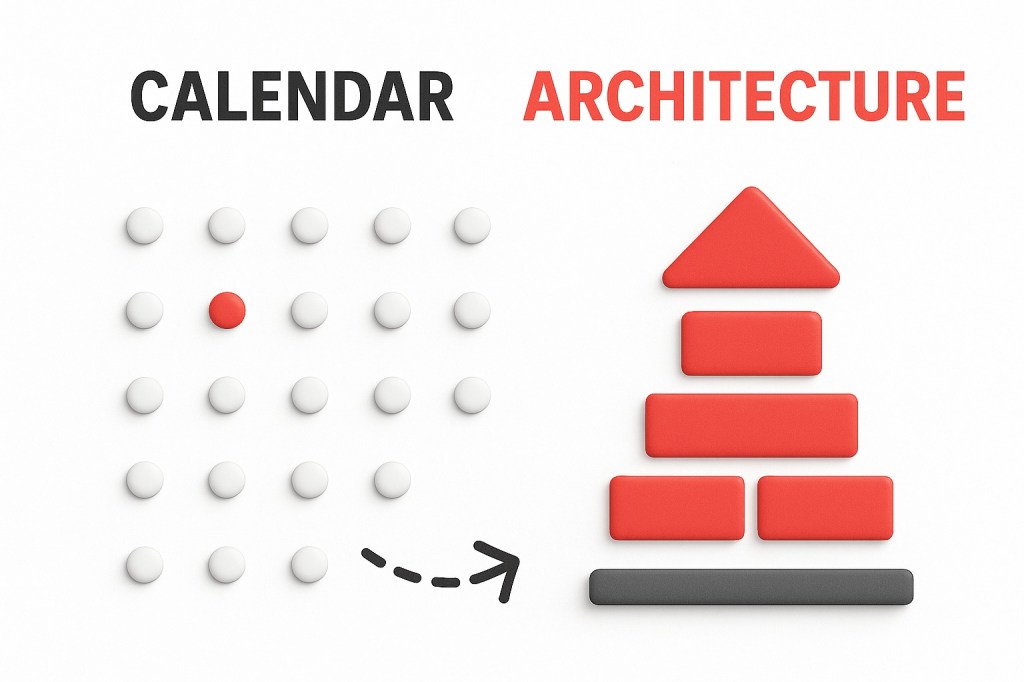
If content fails, strategy fails. Without an architecture, content can never compound as every piece has to fight alone. Understand it this way:
A content calendar is a grocery list: items, quantity, dates.
A content architecture is the recipe: sequence, technique, result.
Calendars reward teams for shipping. Architectures reward organisations for compounding. The job isn’t to fill Tuesdays. The job is to make arguments travel—through the right formats, along the right distribution routes, at the right cadence, with proof built in from the draft.
Put them side by side, and this is what we get:
| Unit | Content Calendar | Content Architecture |
|---|---|---|
| Plans | Slots, dates, deadlines | Thesis, argument, proof |
| Measures | Delivery & velocity | Influence & progression |
| Moves | Tasks forward | Decisions forward |
| Proof | Not required | Instrumented |
| Rewards | Output | Outcomes |
The consequences you actually feel in your org…
Sales. They stop asking for assets. Not because they hate marketing, but because last quarter’s content didn’t help them close any deals. Reps revert to bespoke hacks. Your beautiful content library gathers cache, not cash.
Executives. Signal and noise look identical. Everyone’s busy explaining awareness in the funnel, but no one is measuring persuasion in the pipeline. Budgets get reclassified from ‘growth’ to ‘cost’ because no one can see the causal line.
Brand. Moments don’t stack, voice splits in half: half whispering, half shouting. And thus, content fragments. You sound definitive on Monday, generic by Friday. By the time you fix the inconsistency, it’s Q3 already, and you’re writing another ‘2026 trends’ post no one asked for.
Repairing these drifts later is slower and pricier than building a system now. All of it traces back to the same root: a system that rewards shipping instead of stacking.
When a content calendar does help (but why it doesn’t scale)
For very small teams or new lines of business, a simple calendar creates cadence, reduces decision friction, and gets you visible. Past a certain complexity—multiple products, segments, or regions—cadence without thesis, arguments, routes, and proof turns into motion without momentum. At enterprise scale, consistency without causal proof becomes busywork.
That’s where the content calendar fails, and the content architecture must guide it.
You don’t need to throw away your content calendar. You just need to make it answer to an architecture. Otherwise, every week becomes another spin cycle.
The solution: Architect your content plans
And for that, you need someone who understands content and how it works. A content architect. And no, it’s not another title for a content manager who likes frameworks.
Content managers run the engine day-to-day: keep the lights on, get things out the door. Content architects design the system: set the thesis, define the arguments, map the formats, wire in distribution, and bake in proof—so the work actually compounds and impacts.
Content managers create motion. Content architects create momentum.
Some teams need an architect, others need a manager. Most need both. And very few partners can flex to do both with you. We do both — build the architecture and help you run the engine.
🎯 How we work, and you can too… (pick your path!)
Path A: Build the Architecture (30-day sprint)
- Deliverables: one-breath thesis, 3 arguments, mapped formats, pre-wired routes, proof plan, 90-day content map.
- Outcome: boardroom-ready system that passes the 2-click test.
Path B: Run the Engine (90-day marathon)
- Deliverables: shipped assets against the architecture, enablement placement, opp-note capture, monthly ‘what moved’ review.
- Outcome: shipped work you can trace to opportunities in two clicks.
Curious what this would look like in your org? Shoot us an email 📮 — Use subject line ‘Architect’ or ‘Operate’ and we’ll get in touch with you.
Next up in November: The Content Architecture OS (ConArc™) | The hands-on manual for actually building the system you just realised you don't have. Stay tuned.








 WRDS
WRDS 